
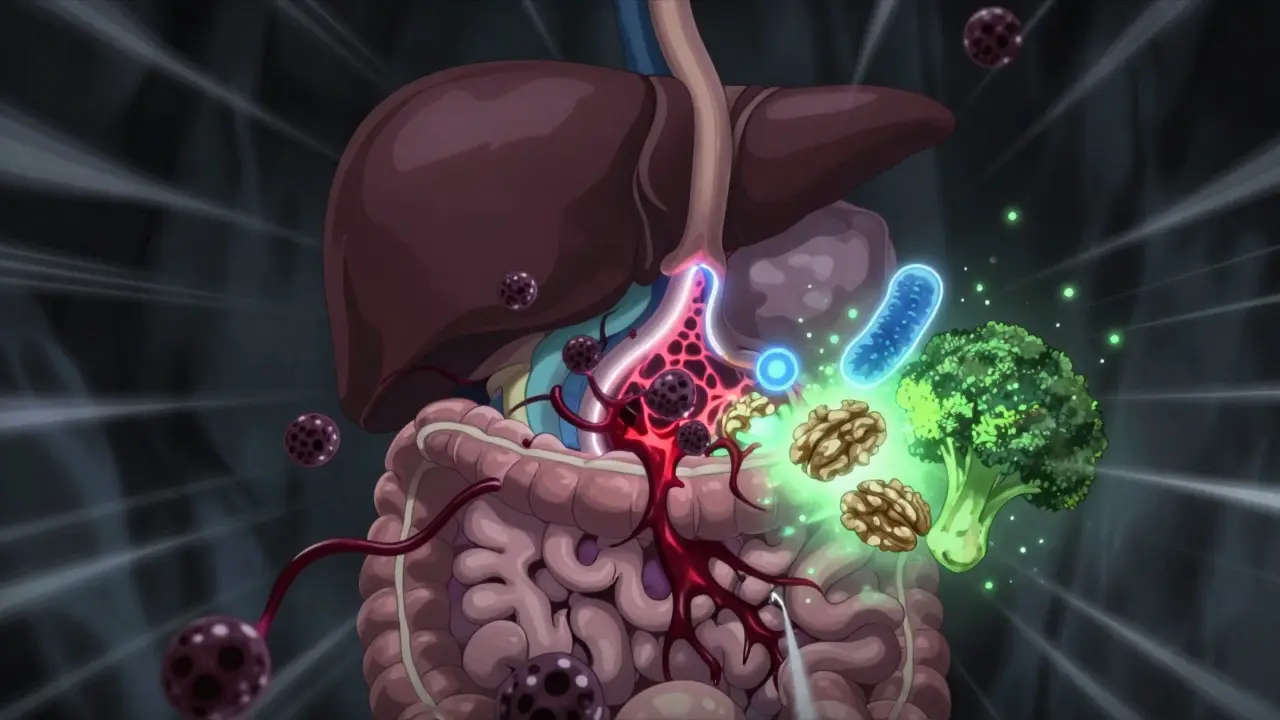
More than one in three adults worldwide has fat buildup in their liver-even if they never drink alcohol. This isn’t just about being overweight. It’s about what’s happening in your gut. Nonalcoholic fatty liver disease (NAFLD), now called metabolic dysfunction-associated steatotic liver disease (MASLD), is quietly becoming the most common liver condition on the planet. And the fix isn’t just cutting calories. It’s healing your gut.
What’s Really Going On in Your Liver and Gut?
Your liver doesn’t work alone. It’s wired directly to your gut through a highway called the portal vein. When your gut lining gets damaged-thanks to poor diet, sugar, or bad bacteria-harmful toxins leak into your bloodstream and head straight for your liver. These toxins, like lipopolysaccharides (LPS), trigger inflammation. That’s how simple fat buildup turns into NASH, fibrosis, and even cirrhosis.
Studies show NAFLD patients have 2.3 times more LPS in their blood than healthy people. At the same time, their gut bacteria are out of balance. Healthy people have a rich mix of microbes. NAFLD patients often have fewer good bacteria like Bacteroides vulgatus and more troublemakers like Lachnospiraceae and Barnesiella intestinihominis. Their gut also produces far less butyrate-a key compound that keeps the gut lining strong and tells your liver to stop storing fat.
People with NAFLD have about 58% less butyrate in their stool than healthy individuals. That’s not a coincidence. It’s a signal. Your gut isn’t just digesting food-it’s sending messages to your liver. And right now, those messages are telling your liver to store fat, not burn it.
Weight Loss Isn’t Optional-It’s the Foundation
There’s no magic pill for NAFLD. But there is one treatment that works consistently: losing weight. And you don’t need to drop 50 pounds. Losing just 5% of your body weight improves liver fat in 81% of people. Hit 7-10%, and nearly half of those with NASH see their inflammation and scarring reverse.
That’s not theory. That’s data from a 2023 meta-analysis of over 10,000 patients. The key? Gradual loss. Aim for 0.5 to 1 kg (1-2 lbs) per week. Faster weight loss can actually stress your liver. Slow and steady gives your body time to heal.
Most people try dieting alone. But combining diet with movement makes a bigger difference. People who added 150 minutes of walking or cycling per week to a calorie-restricted diet saw their liver enzyme levels drop twice as much as those who only ate less. You don’t need to run marathons. Just move more every day.
The Gut-Healing Diet: What to Eat
Not all diets are equal when it comes to NAFLD. The Mediterranean diet keeps showing up in studies-not because it’s trendy, but because it works. It’s rich in olive oil, vegetables, nuts, legumes, and whole grains. It’s low in sugar, processed foods, and fried stuff.
A 6-month trial with 70 NAFLD patients showed that eating 30 grams of walnuts daily (about 2 handfuls) cut liver fat by 32%. Walnuts are packed with fiber and polyphenols that feed good gut bacteria. Other winners: broccoli, Brussels sprouts, artichokes, lentils, and oats. These are prebiotics-food for your good bugs.
Watch your fructose. That’s the sugar in soda, candy, and even fruit juice. More than 25 grams a day can overload your liver and worsen fat buildup. A single can of soda has 39 grams. Swap it for water, herbal tea, or sparkling water with lemon.
Fat isn’t the enemy here. Healthy fats are essential. Aim for 25-35% of your calories from monounsaturated fats-olive oil, avocados, almonds, and fatty fish like salmon. These reduce inflammation and help your liver process fat better.
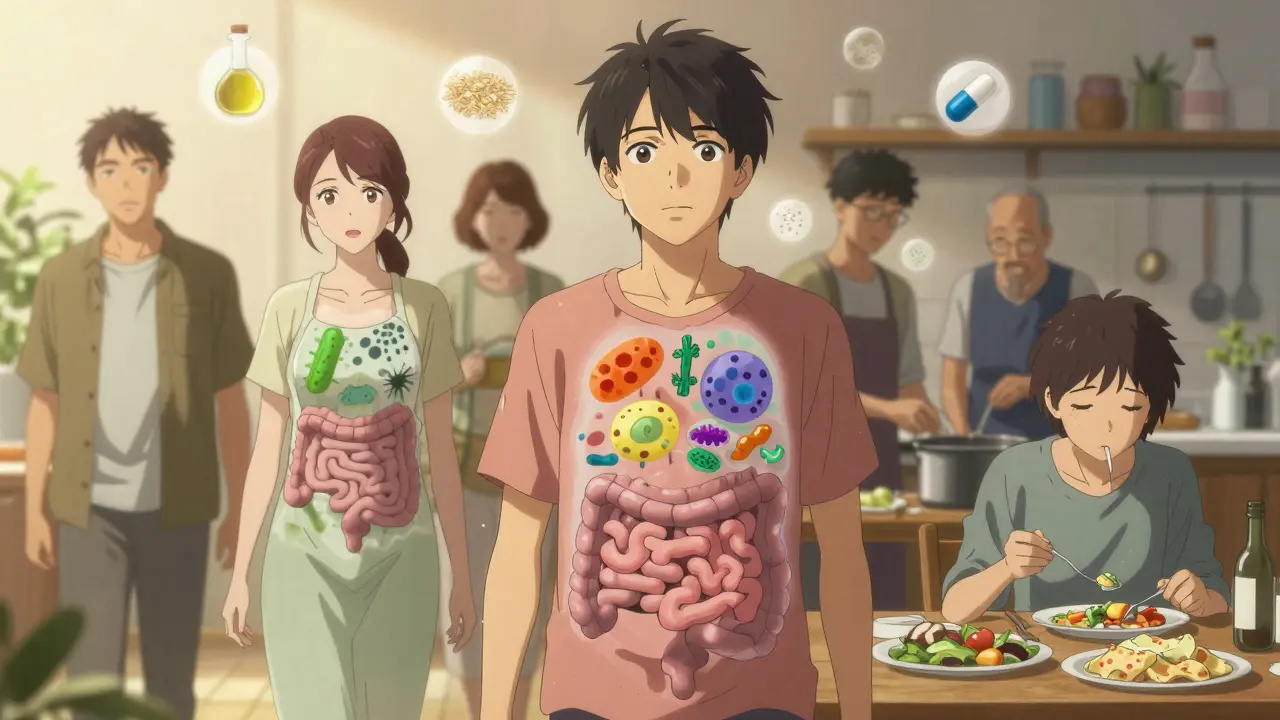
Probiotics and Prebiotics: Do They Help?
Yes-but with caveats. Not every probiotic supplement works. You need the right strains, in the right dose, for long enough.
In a double-blind study of 100 NAFLD patients, taking a daily mix of Lactobacillus rhamnosus GG, Bifidobacterium longum, and Streptococcus thermophilus for 24 weeks reduced liver fat by 23% and lowered ALT (a liver enzyme marker) by 31%. That’s as good as some prescription drugs.
Prebiotics like inulin and fructooligosaccharides (FOS) also help. Taking 10 grams of inulin daily for 12 weeks boosted butyrate levels by 47% and reduced liver stiffness-a sign of early scarring.
But here’s the catch: You need to take them consistently for at least 12 weeks. Most people give up after 4 weeks. And not all probiotics are created equal. Look for products with at least 10 billion CFUs per dose and multiple strains. Single-strain supplements rarely move the needle.
The American Association for the Study of Liver Diseases says probiotics are “potentially beneficial” but not yet standard care. That’s because results vary. But for many, they’re a helpful tool-especially when paired with diet and weight loss.
What Doesn’t Work (And Why)
Intermittent fasting gets a lot of buzz on Reddit. Some people swear by the 5:2 diet. And yes, cutting calories on two days a week can help. But it’s not magic. If you binge on junk food the other five days, your gut stays damaged. Fasting without better food choices won’t fix your microbiome.
Detox teas, liver cleanses, and supplements like milk thistle? No solid proof they help NAFLD. Some even harm your liver. Stick to evidence-backed approaches.
And forget about extreme diets. Keto, carnivore, or juice fasts might drop weight fast-but they often make gut diversity worse. Low-fiber diets starve your good bacteria. You might lose weight, but your liver could still be inflamed.

Real People, Real Results
In a study across 15 European hospitals, 78% of NAFLD patients said their bloating and digestion improved within four weeks of starting probiotics and eating more fiber. But 22% quit because of gas or stomach upset. Side effects are real-but usually temporary. Start slow. Add fiber gradually. Drink more water.
On Reddit’s NAFLD community, 63% of users reported feeling less tired and less bloated after switching to a Mediterranean-style diet. The most popular strategy? Cutting out soda and eating more vegetables. But 41% said sticking to it was hard-especially at parties, family dinners, or when stressed.
The Mayo Clinic found that people who followed a structured program with diet coaching, exercise, and behavioral support kept their weight off and maintained liver health 68% of the time after two years. Those who tried to do it alone? Only 29% succeeded.
Support matters. Whether it’s a nutritionist, a support group, or just a friend who eats healthy too-having someone in your corner makes a huge difference.
What’s Coming Next
The future of NAFLD treatment is being built on the gut. Companies like Vedanta Biosciences are developing defined bacterial mixtures designed to activate receptors that reduce liver fat. Early results show a 38% drop in liver fat after 24 weeks. These aren’t probiotics you can buy at the store-they’re precision medicines.
By 2030, most hepatologists expect gut microbiome testing to become part of routine NAFLD care. Imagine a simple stool test telling you exactly which bacteria you’re missing-and what to eat to bring them back.
But for now, the tools we have are powerful enough. You don’t need to wait for the next breakthrough. Start today. Eat more fiber. Lose 5% of your weight. Move more. Take a quality probiotic. Your liver-and your gut-will thank you.
Simple Steps to Start Healing Your Liver and Gut
- Reduce sugar-especially fructose. Avoid soda, candy, and sweetened drinks.
- Add 25-30 grams of fiber daily from vegetables, legumes, oats, and nuts.
- Swap processed fats for olive oil, avocado, and fatty fish.
- Target a 5-10% weight loss over 6-12 months. Aim for 0.5-1 kg per week.
- Take a multi-strain probiotic with at least 10 billion CFUs daily for at least 12 weeks.
- Walk 30 minutes a day, 5 days a week. No gym needed.
- Drink more water. Dehydration worsens gut and liver function.
Can NAFLD be reversed without losing weight?
No. Weight loss is the only proven way to reverse liver fat and inflammation in NAFLD. Even small losses-5% of body weight-can improve liver health significantly. Without weight loss, dietary changes and probiotics may help a little, but they won’t fully reverse the condition.
Is the Mediterranean diet the best for NAFLD?
Yes, current evidence shows the Mediterranean diet is the most effective eating pattern for NAFLD. It’s rich in fiber, healthy fats, and antioxidants, and it supports a diverse gut microbiome. Studies show it reduces liver fat, lowers inflammation, and improves insulin sensitivity better than low-fat or low-carb diets.
Do probiotics really help with fatty liver?
Yes, but only specific strains in the right doses. Probiotics containing Lactobacillus rhamnosus GG, Bifidobacterium longum, and Streptococcus thermophilus have been shown in clinical trials to reduce liver fat by up to 23% and lower liver enzymes by 31%. They work best when combined with diet and weight loss-not as a standalone fix.
How long does it take to see improvements in NAFLD?
You can see early improvements in liver enzymes and digestion within 4-8 weeks of starting a healthy diet and probiotics. But meaningful reduction in liver fat and inflammation usually takes 6-12 months of consistent lifestyle changes. Patience and persistence are key.
Can I take probiotics if I have bloating or IBS?
Yes, but start slowly. Some people with IBS or bloating may feel worse at first as their gut adjusts. Choose a probiotic with well-researched strains and begin with a lower dose. Increase gradually. Pair it with soluble fiber (like oats or psyllium) to help reduce gas. If symptoms persist, talk to a doctor.
Is fasting good for NAFLD?
Time-restricted eating (like eating within an 8-hour window) can help reduce calorie intake and improve insulin sensitivity, which benefits NAFLD. But it’s not a magic solution. If you overeat unhealthy foods during your eating window, fasting won’t help. Focus on food quality first, then consider timing as a tool.


Pankaj Singh
January 12 2026This article is pure pseudoscience dressed up as medicine. You think eating walnuts fixes NAFLD? Bro, your liver isn't a garden you can fertilize with fiber. The only thing that matters is insulin resistance, and no amount of probiotics or Mediterranean diet fixes that if you're still eating carbs. Stop selling snake oil.