

When a pharmaceutical company makes even a small change to how a drug is made - like swapping out a machine, moving a step to a different room, or tweaking a chemical process - it’s not just an internal decision. It’s a regulatory event. The manufacturing changes you think are minor could trigger a legal requirement to notify or get approval from the FDA, EMA, or other health agencies. Skip this step, and you risk a warning letter, a product recall, or even a shutdown. This isn’t about bureaucracy. It’s about safety.
Why Manufacturing Changes Matter
Every drug on the market was approved based on a specific way of making it. That includes the ingredients, the equipment used, the factory location, and even the temperature during mixing. If any of those things change after approval, regulators need to know. Why? Because even tiny changes can affect the drug’s identity, strength, purity, or how well it works in your body.Take a simple example: replacing a tablet press. Sounds harmless, right? But if the new machine applies pressure differently, the tablet might dissolve too fast or too slow. That could mean you get too much or too little medicine. That’s not a small risk. That’s a patient risk.
The FDA, EMA, and Health Canada all agree: change must be controlled. But how you handle it depends on how risky the change is. There’s no one-size-fits-all rule. You have to assess the risk - and then act accordingly.
The Three-Tier System (FDA’s Approach)
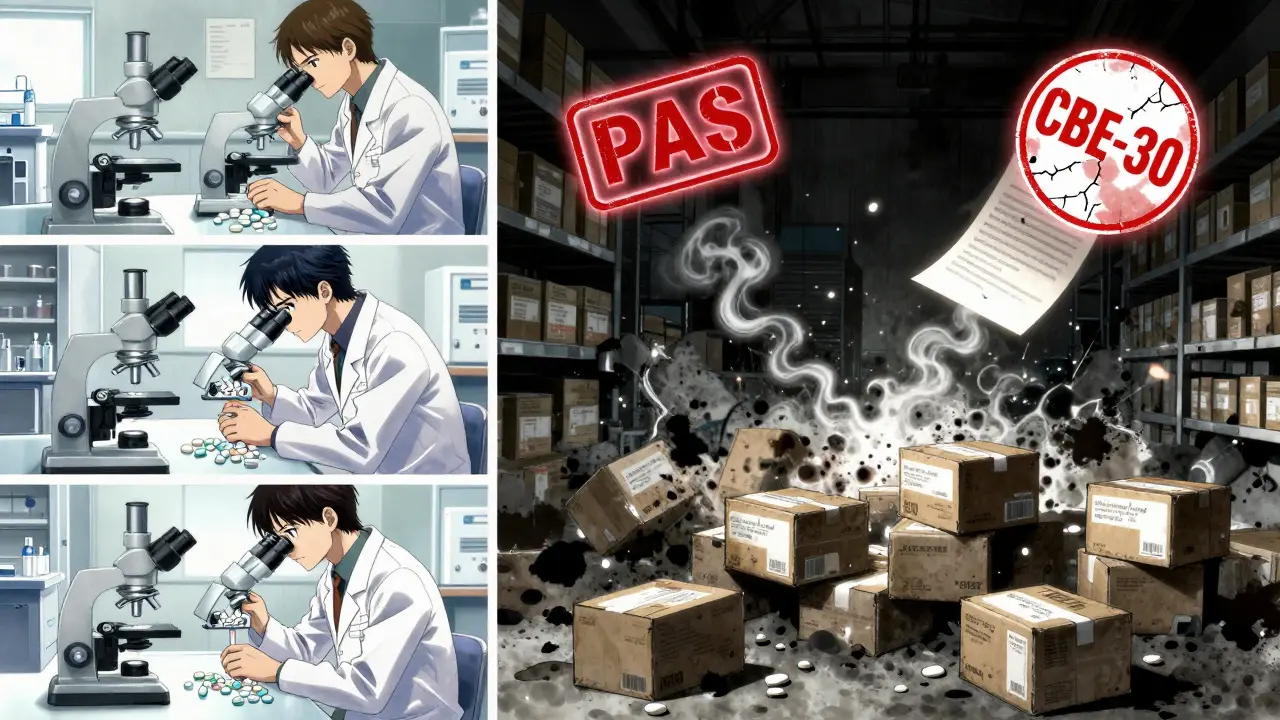
In the U.S., the FDA uses a clear, three-category system for managing manufacturing changes. It’s based on risk. If you get it wrong, you’re in trouble.- Major Changes (Prior Approval Supplement - PAS): These are changes with a high chance of hurting product quality. Examples: switching to a new synthetic route for the active ingredient, moving production to a brand-new factory, or changing equipment that affects critical process parameters. You must get FDA approval before you start making the drug this way. No exceptions. Violate this, and you’re breaking federal law.
- Moderate Changes (CBE-30 or CBE-0): These are changes that could affect quality, but not as severely. Think: replacing a machine with an identical model from the same manufacturer, or changing a non-critical component in a mixer. You can make the change and start production after submitting a CBE-30 notice - but you have to wait 30 days before shipping the product. CBE-0 is for emergencies, like fixing a defect that affects safety or purity. You can act immediately, but you still have to notify the FDA right away.
- Minor Changes (Annual Report): These are the lowest risk. Moving a packaging line within the same building? Changing the font on a label? Updating a calibration schedule? These go into your annual report. No advance notice. Just document it and file it when your yearly submission is due.
The key? You don’t guess. You assess. And you document. The FDA’s 2021 guidance for biologics even includes a table listing common changes and their recommended categories. Use it.
How Other Regions Compare
The U.S. isn’t alone. Europe and Canada have similar systems - but with different names and timelines.The European Medicines Agency (EMA) uses Type IA, IB, and II:
- Type IA: Very minor. You can implement immediately and notify within 12 months.
- Type IB: Moderate. You must wait for approval before implementing. Approval usually takes 30-60 days.
- Type II: Major. Full review required. Can take 60-120 days.
Health Canada’s system mirrors the FDA’s:
- Level I: Prior approval needed (like PAS).
- Level II: Notify and wait 30 days (like CBE-30).
- Level III: Annual report (same as FDA).
The big difference? The EMA lets you do Type IA changes without any advance notice. The FDA doesn’t have that. That’s why some companies find the European system more flexible - but also more confusing if you operate globally.
What Counts as a “Change”?
It’s not just about equipment. Here’s what triggers a notification:- New or different equipment (even if it’s the same model from the same vendor - if it’s not identical in critical specs)
- Changing the location of a critical process step (even within the same facility)
- Switching suppliers for raw materials or packaging
- Modifying cleaning procedures for equipment
- Updating software that controls a manufacturing process
- Changing validation protocols or testing methods
Here’s a real example: A company replaced a filter in a purification line. The new filter had the same pore size and material - but a different brand. The team assumed it was a minor change. They didn’t notify anyone. Months later, the FDA found inconsistencies in batch purity. The filter was the culprit. Result? A warning letter and a recall.
Don’t assume. Check the guidance. If you’re unsure, ask the agency.
How Companies Handle It (And Where They Fail)
Large companies like Pfizer have internal risk scoring tools - 15-point checklists that weigh factors like impact on critical quality attributes, process history, and validation status. They spend hundreds of hours per change. But they’re prepared.Smaller companies? They struggle. A regulatory affairs specialist on Reddit shared that classifying a tablet press replacement took 37 hours of meetings. Why? Because the API’s particle size specs were vague. Was the change risky? No one could agree.
And it’s expensive. In 2022, 22% of all FDA warning letters were due to misclassified manufacturing changes. Nearly 40% of those were equipment-related. That’s not just a compliance issue - it’s a financial one. A single recall can cost millions.
The best companies don’t just follow rules. They build systems. They train teams. They use Failure Modes and Effects Analysis (FMEA) - a risk tool from manufacturing engineering - to predict how a change might go wrong. The Parenteral Drug Association recommends this. The FDA expects it.

What You Need to Do
If you’re responsible for manufacturing changes, here’s what you need to do right now:- Know your product’s critical quality attributes (CQAs). What features define safety and effectiveness? Strength? Dissolution? Purity? Write them down.
- Map every process step. Which steps affect CQAs? Those are your critical process parameters (CPPs). Any change to those? High risk.
- Use the FDA’s 2021 guidance. It lists common changes and their categories. Download it. Print it. Keep it on your desk.
- Document everything. Not just the change - but the risk assessment. Who reviewed it? What data did you use? What did you compare it to? Three consecutive batches of data? Include it.
- When in doubt, ask. The FDA says: If you’re unsure, contact them early. They’ll tell you if you’re wrong. Better than getting a warning letter.
The Future: Harmonization and Risk-Based Thinking
The industry is moving toward ICH Q12 - a global guideline that wants to simplify change management. It’s not magic. But it encourages companies to use quality risk management (ICH Q9) to justify changes, not just check boxes.By 2025, more companies will use real-time monitoring data to prove a change didn’t hurt quality. Think sensors that track temperature, pressure, and particle size as the drug is made. That data can replace some batch testing. That’s the future.
But for now? The rules are clear. The consequences are real. And the cost of getting it wrong? Higher than most companies realize.
What happens if I make a manufacturing change without notifying the FDA?
You’re in violation of federal law. The FDA can issue a warning letter, seize your product, order a recall, or even halt production. In 2022, 22% of all FDA warning letters were due to unapproved manufacturing changes. One company was forced to recall 1.2 million units after replacing a mixer without a PAS. The cost? Over $18 million.
Can I make a change and notify the FDA later?
Only for moderate changes using a CBE-30. You can implement the change and ship product after submitting the notice - but you must wait 30 days. For major changes (PAS), you must wait for approval before any production. For minor changes, you can wait until your annual report. Never assume a change is minor without documentation.
What’s the difference between CBE-30 and PAS?
CBE-30 lets you make the change after submitting a notice - you just can’t ship for 30 days. PAS requires FDA approval before you make any change or ship any product. PAS is for high-risk changes: new facilities, new processes, or changes that affect critical quality attributes. CBE-30 is for moderate changes, like replacing equipment with an identical model.
Do I need to validate equipment after replacing it?
Yes - always. Even if the new equipment is identical, you must revalidate it. The FDA requires comparative data from at least three consecutive batches made with the new equipment. You must prove the product’s quality hasn’t changed. This includes testing for potency, impurities, dissolution, and stability.
How long does it take to get FDA approval for a PAS?
Typically 60-180 days. The FDA has 180 days to review a PAS, but many are approved faster if the submission is complete. Delays happen when documentation is incomplete or if the agency requests additional data. Plan ahead. Don’t wait until the last minute.
Are there tools to help classify manufacturing changes?
Yes. The FDA’s 2021 final guidance for biologics includes a table with over 50 common changes and their recommended category. The Parenteral Drug Association’s TR-60 provides a risk assessment framework using FMEA. Many companies build internal scoring systems based on these. Use them. Don’t rely on gut feeling.


Sabrina Sanches
March 13 2026I've seen so many small changes blow up because someone thought 'it's just a swap'... God, I wish more teams had a checklist. This post is a lifesaver. Seriously, print this and tape it to your desk. 🙏