

When standard antidepressants don't work, the feeling of hopelessness can be overwhelming. About 29.7% of people with major depressive disorder don't respond to two or more traditional medications. This is where treatment-resistant depression (TRD) comes into play, and for those stuck in this loop, two rapid-acting options have changed the conversation: ketamine and esketamine. While they sound similar, they are different tools with different delivery methods, costs, and results.
What exactly are these treatments?
First, let's clear up the chemistry. Ketamine is a dissociative anesthetic first approved by the FDA in 1970. In the context of mental health, it's used at "subanesthetic" doses-meaning doses low enough that you don't lose consciousness, but high enough to flip a switch in your brain's chemistry. It is a racemic mixture, meaning it contains both (R)- and (S)-enantiomers (basically, two mirror-image versions of the molecule).
Then there is Esketamine, which is the (S)-enantiomer of ketamine, delivered as a nasal spray under the brand name Spravato®. Approved for depression in 2019, esketamine is designed to be a more targeted version of the original drug. Because it only contains one of the two molecular mirrors, it often produces less intense dissociative effects than the full racemic version.
The speed and strength: Which works faster?
If you're dealing with severe, life-threatening depression or acute suicidal thoughts, speed is everything. Research shows a clear winner in the race for rapid relief. A 2025 study from Harvard-affiliated Mass General Brigham found that IV ketamine is generally more powerful. Patients saw a 49.22% reduction in depression scores by their final dose, while those using nasal esketamine saw a 39.55% reduction.
The onset of action is also a major differentiator. IV ketamine often works almost immediately after the first treatment. In contrast, esketamine typically requires at least two treatments before patients notice a significant lift in mood. If you need a response right now, the intravenous route is the heavy hitter.
| Feature | IV Ketamine | Intranasal Esketamine (Spravato®) |
|---|---|---|
| FDA Status | Off-label for depression | FDA-approved for TRD |
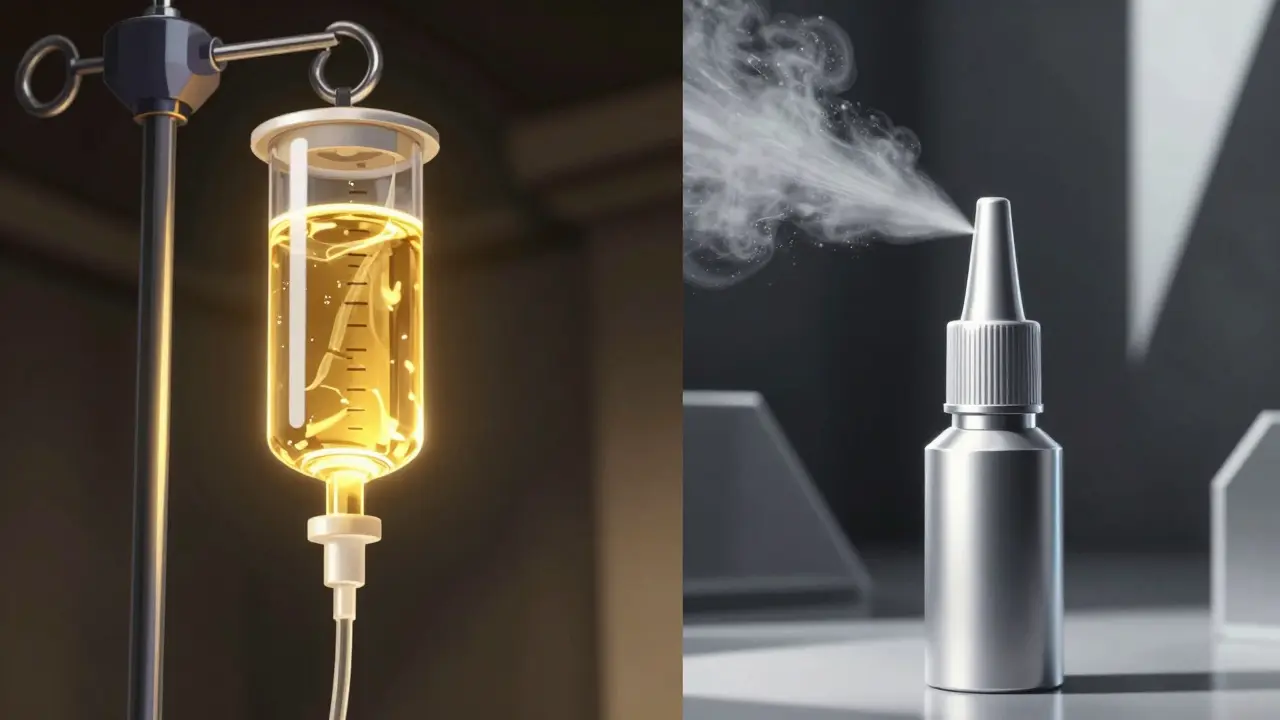
| Administration | Intravenous (IV) infusion | Nasal spray |
| Typical Efficacy (Symptom Reduction) | Higher (~49%) | Moderate (~39%) |
| Onset Speed | Immediate/First dose | Slower (usually 2+ doses) |
| Dissociation Risk | Higher (Approx 42%) | Lower (Approx 29%) |
The experience: Dissociation and Side Effects
Neither of these is a "take it and go" medication. Both require medical supervision and a mandatory two-hour monitoring period after the dose. However, the feeling of the treatment differs. Many people describe a "dissociative" experience-a feeling of being detached from their body or environment. This is more common with IV ketamine, where about 42.3% of patients report these effects.
Esketamine is generally perceived as "smoother." Real-world data from patient forums like PatientsLikeMe shows that while IV ketamine is more effective for some, 78.4% of esketamine users rated their overall experience as good or excellent. They prefer the non-invasive nature of a spray over a needle and find the dissociative "trip" less intense. If you are needle-phobic or anxious about feeling "out of it," esketamine is the more comfortable choice.
The money talk: Costs and Insurance
Let's be honest: cost is a huge barrier. Because IV ketamine is used off-label for depression, insurance companies are often reluctant to pay for it. Only about 38.2% of commercial plans cover IV infusions. A full course of eight treatments usually costs between $4,200 and $5,600 out of pocket.
Spravato® (esketamine) is more expensive upfront-roughly $5,800 to $6,900 for a comparable course-but it has much better insurance coverage. About 67.4% of commercial plans cover it because it has a specific FDA indication for TRD. This means for many, the "more expensive" drug is actually cheaper because the insurance company picks up the tab.
Long-term maintenance and the road ahead
Getting out of a depressive episode is one thing; staying out is another. Long-term data suggests that both treatments require maintenance. A 2024 multicenter trial found that 56.3% of IV ketamine responders stayed in remission at six months with doses every 1-3 weeks. Esketamine followed closely, with 48.7% maintaining remission.
We are also seeing a shift in how doctors predict who will respond. New research into EEG biomarkers suggests that increases in "gamma power" in certain brain regions can predict if a patient will respond well to ketamine. This means in the near future, we might stop guessing and start using brain scans to pick the right treatment.
Which one should you choose?
The choice usually comes down to your specific needs and your tolerance for side effects. If you are in a crisis, dealing with severe suicidal ideation, and need the fastest possible response, the evidence points toward IV ketamine. It's more cost-effective per "quality-adjusted life year" and hits harder and faster.
On the other hand, if you prefer convenience, a better safety profile, and the likelihood of insurance coverage, esketamine is the way to go. It's better suited for outpatient settings and long-term maintenance where the intensity of the treatment is less important than the consistency of the dose.
Is ketamine addictive?
Both ketamine and esketamine are classified as Schedule III controlled substances. While they have a potential for abuse, the risk is minimized in clinical settings because the medication is administered and monitored by healthcare professionals. You cannot take these home; they must be given in a clinic.
Do I need to stop taking my current antidepressants?
Not necessarily. In fact, the FDA-approved use of esketamine (Spravato®) specifically requires it to be used in conjunction with an oral antidepressant. For IV ketamine, your doctor will determine if your current meds interfere, but many patients continue their standard regimen.
What are the most common side effects?
The most common side effects include temporary dissociation, a feeling of detachment, increased blood pressure, and occasional nausea. These effects usually wear off within a few hours after the treatment session ends.
How many treatments are typical in a first course?
A typical induction phase often involves about eight treatments over several weeks. For esketamine, this usually means two doses per week. For IV ketamine, the schedule can vary, but a series of 6-8 infusions is common to establish a baseline of relief.
Can I get these treatments at home?
No. Due to the risk of dissociation and the need to monitor blood pressure, both IV ketamine and intranasal esketamine must be administered in a medical clinic. A two-hour post-treatment monitoring period is mandatory for safety.
Next steps and troubleshooting
If you're considering these options, start by asking your psychiatrist about "Treatment-Resistant Depression." Not everyone qualifies for these treatments; usually, you must have failed at least two different antidepressant trials first.
- If you have limited insurance: Look specifically for clinics offering Spravato®, as they are more likely to be in-network.
- If you are in an acute crisis: Discuss IV ketamine with a provider, as the onset of relief is typically faster.
- If you are anxious about needles: Request a consultation for the intranasal esketamine spray.