

Imagine the relief of finally getting your health routine under control. You've got your weekly box, your pills are sorted, and you no longer have to wonder, "Did I take my blood pressure medication this morning?" But here is the scary part: if you use that box the wrong way, you might actually be increasing your risk of a medical emergency. According to a 2022 study in the Journal of the American Geriatrics Society, improper use of pill organizers can spike overdose risks by 23% in elderly patients. It sounds counterintuitive, but a tool designed for safety can become a hazard if you treat it as a "set it and forget it" system.
The goal isn't just to put pills in a box; it's to build a fail-safe system that removes guesswork. When done right, pill organizer is a compartmentalized container designed to help individuals manage multiple medications by time of day and day of week. Used correctly, these tools can reduce missed doses by 32% and cut accidental double-dosing by 18%. The secret lies in a strict protocol of filling, storing, and verifying.
The Golden Rule: Never Put "As Needed" Meds in the Box
If there is one mistake that leads to the most emergency room visits, it's putting PRN (as needed) medications in a daily organizer. Whether it's a strong painkiller or an anti-anxiety med, these do not belong in your weekly slots. Why? Because when you see a pill in a "Tuesday" slot, your brain assumes it's a scheduled dose. If you've already taken your as-needed dose from the original bottle and then take the one in the organizer, you've just double-dosed.
Data from WebMD and Memorial Sloan Kettering shows that 38% of accidental overdoses happen because patients confuse scheduled medications with as-needed ones. Keep your PRN meds in their original pharmacy bottles. This creates a physical and mental boundary between "I must take this" and "I take this only if I feel pain/symptoms."
Choosing the Right Tool for Your Needs
Not all pill boxes are created equal. A simple plastic tray from a drugstore is fine for one or two vitamins, but if you're managing a complex regimen, you need a more robust system. You should look for child-resistant features that meet ASTM F3130-15 standards, especially if you have grandkids visiting. For those with visual impairments, Braille labeling is a lifesaver to prevent mixing up morning and evening doses.
| Organizer Type | Best For | Safety Level | Key Drawback |
|---|---|---|---|
| Basic Weekly (7-day x 1) | Simple daily vitamins | Low | No dose-time separation |
| Multi-Dose Daily (7-day x 4) | Chronic illness management | Medium | Manual verification required |
| Electronic/Smart Organizers | High-risk polypharmacy | High | Higher cost / battery dependency |
The Fail-Safe Filling Protocol
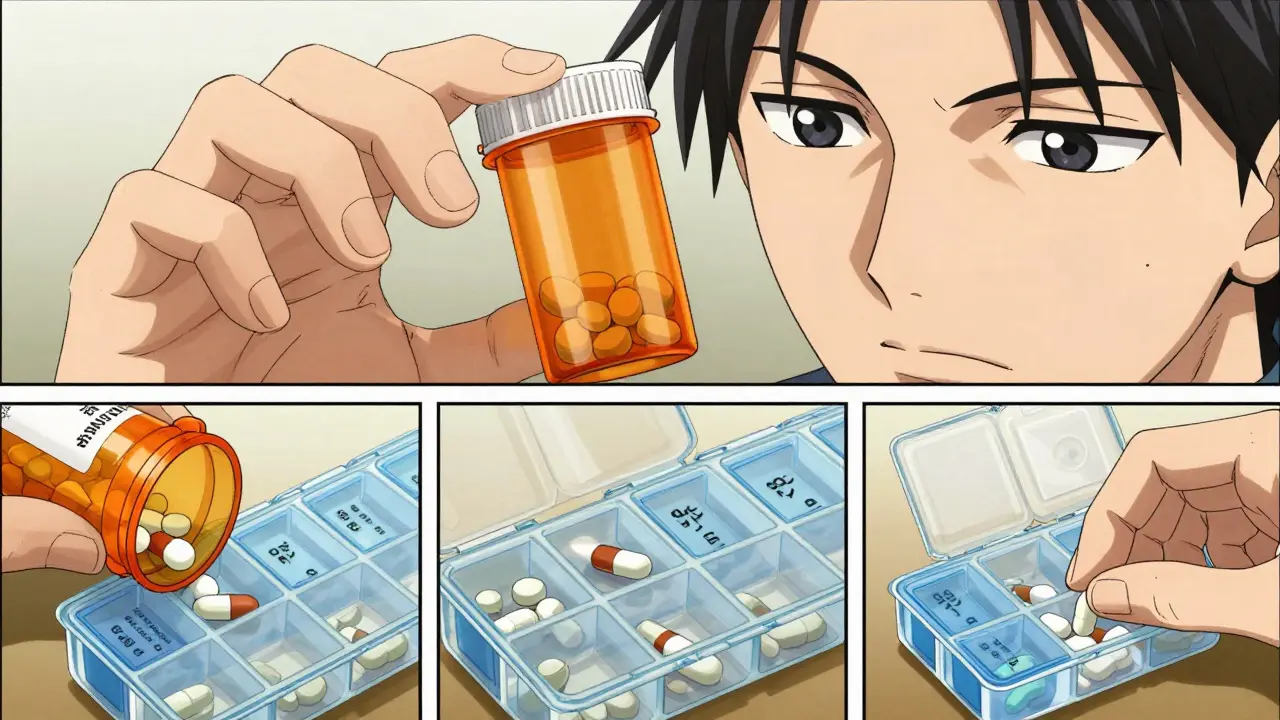
Most errors happen during the filling process, not the taking process. A common mistake is pouring several different bottles into the compartments at once. This is how pills get mixed up or double-counted. Instead, adopt the "one medication at a time" method. This simple shift can reduce double-dosing errors by 63%.
Follow these exact steps every time you refill your box:
- Cleanse: Wash your hands with soap for 20 seconds. This prevents contamination of your medication.
- Verify: Lay out your current, updated medication list. Do not rely on the labels of old bottles if your doctor recently changed a dose.
- Isolate: Take one bottle. Fill every single compartment for the week for that specific medication.
- Confirm: Check the bottle label against the compartment. Once finished, put that bottle away before touching the next one.
- Final Scan: Once the box is full, do a visual sweep of every day to ensure no compartment is overfilled or suspiciously empty.
Give yourself at least 15 to 20 minutes for this process. Rushing through your meds is a recipe for a mistake. Many people find that filling their organizer on the same day each week-like Sunday morning-helps create a mental habit that ensures no gaps in the schedule.
Where (and Where Not) to Store Your Organizer
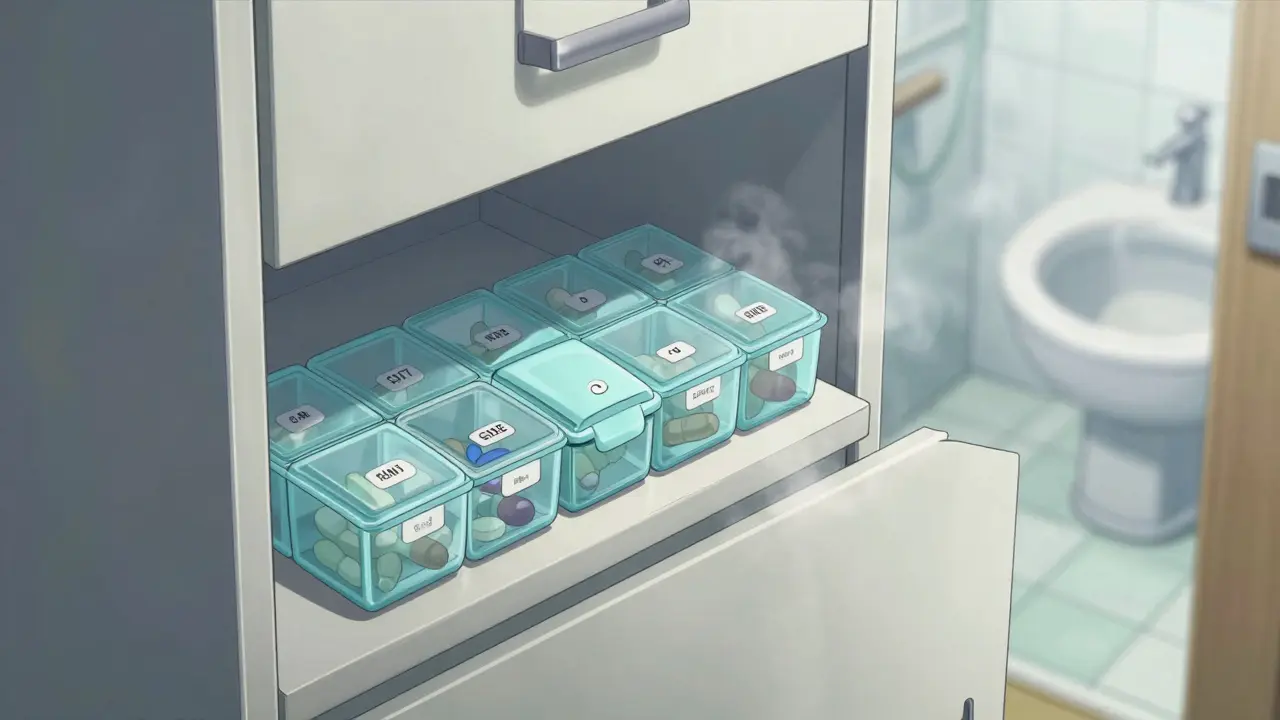
You might be tempted to keep your pill box on the bathroom counter for convenience. Don't do it. The steam from your shower creates a high-humidity environment that can degrade your medication. Some studies show that pills degrade up to 47% faster in high humidity, which can make them less effective or cause them to crumble.
Keep your organizer in a cool, dry place, ideally below 86°F (30°C). A kitchen cabinet or a bedside table is usually a much safer bet. Also, be aware that certain medications are absolute "no-gos" for organizers. If a drug requires refrigeration, must stay in a foil blister pack to protect it from light, or is a soft gel capsule that sticks to plastic, keep it in the original packaging. Using a box for these types of meds can lead to chemical degradation.
Dealing with "Look-Alike" Pills
It's easy to confuse two small white round pills, especially if you're tired or the lighting is poor. This is a leading cause of accidental overdose. If you have medications that look identical, consider using two separate organizers-one for "morning/afternoon" and one for "evening/night"-to create more distance between them. Alternatively, keep a physical "pill map" next to your box that lists the color and shape of each med for that day.
For those who struggle with this, a pill splitter with a color-coding system can help, but always consult your pharmacist before splitting any medication, as some extended-release tablets can be dangerous if broken.
Leveraging Technology and Professional Help
If you feel overwhelmed by your medication list, you don't have to do this alone. About 68% of U.S. pharmacies now offer professional organizer filling services. Having a pharmacist verify your setup can reduce your error rate by 52%. It takes the pressure off you and adds a professional layer of safety.
If you have a high-risk condition or a very long list of meds, Smart Pill Organizers are a great investment. Modern versions now include usage tracking and automatic alerts if you try to open a compartment too soon after a previous dose. Setting a simple phone alarm 15 minutes before your dose time can also reduce verification errors by 44% by ensuring you aren't rushing the process.
Can I put all my medications in one pill organizer?
No. You should never put "as needed" (PRN) medications, liquids, refrigerated drugs, or moisture-sensitive medications (like certain soft gels) in an organizer. Only scheduled, solid oral medications that are stable at room temperature should be placed in the compartments.
How often should I replace my pill organizer?
You should replace your organizer if the plastic becomes brittle, the lids no longer snap shut securely, or the labels fade. Degraded compartments can allow moisture in or cause pills to get stuck, increasing the risk of dosing errors.
What should I do if I realize I missed a dose?
Do not double up on the next dose to "catch up," as this is a primary cause of accidental overdose. Check your medication's specific instructions or call your pharmacist to ask whether you should take the missed dose immediately or wait until the next scheduled time.
Is it safe to store my pill box in the bathroom?
No. Bathrooms are typically too humid due to showers and sinks. High humidity can cause medications to degrade significantly faster, potentially making them ineffective or unstable.
How do I prevent my kids from getting into my pill box?
Purchase an organizer that specifically lists "child-resistant" features and meets ASTM F3130-15 standards. Regardless of the lock, always store the organizer in a high cabinet or a locked drawer that is out of reach and sight of children.
Next Steps for Better Safety
If you are currently using a pill box, take ten minutes today to audit your setup. Check if any "as needed" meds have crept into your daily slots and move them back to their original bottles. If you're managing more than five medications, consider scheduling a "medication review" with your pharmacist to ensure your current list is accurate and your storage method is safe.
For caregivers, the best move is to implement the one-medication-at-a-time filling method and a weekly verification log. Tracking when the box was filled and by whom adds a layer of accountability that can drastically reduce hospital visits related to medication errors.