

When you pick up a prescription, you might be handed a pill bottle labeled with a name you don’t recognize. That’s not a mistake. It’s likely a generic drug - a cheaper version of the brand-name medication your doctor prescribed. In most states, pharmacists are legally allowed to swap the brand for the generic without asking you first. But not all states work the same way. Some require you to give permission. Others block substitutions entirely for certain drugs. And when it comes to biologics - complex, injectable medications like those for rheumatoid arthritis or psoriasis - the rules get even more confusing.
What Exactly Is Pharmacy Substitution?
Pharmacy substitution laws let pharmacists replace a brand-name drug with a generic version, as long as it’s approved by the FDA as therapeutically equivalent. These laws exist because generics cost 80-85% less than brand-name drugs. In 2023, generics made up 90% of all prescriptions filled in the U.S., but only 23% of total drug spending. That’s over $313 billion saved in one year alone. But here’s the catch: not all drugs are created equal. For most medications - like high blood pressure pills or antibiotics - swapping generics is safe and effective. But for drugs with a narrow therapeutic index (NTI), even tiny differences in how the body absorbs the drug can cause serious problems. Think warfarin (a blood thinner), phenytoin (for seizures), or lithium (for bipolar disorder). That’s why some states have special rules.How Your State Handles Substitution: Mandatory, Permissive, or Restrictive
All 50 states and Washington, D.C. have laws about substitution, but they fall into three basic categories:- Mandatory substitution (19 states): The pharmacist must substitute unless the doctor says "dispense as written." States like California, New York, and Texas fall into this group.
- Permissive substitution (31 states + D.C.): The pharmacist can substitute, but doesn’t have to. They can choose to give you the brand if they think it’s better - or if you ask.
- Restrictive (none currently): No state outright bans substitution for all drugs. But many have lists of drugs that can’t be swapped, especially NTI drugs.
Do You Need to Give Consent?
This is where things get personal. In 7 states plus D.C., pharmacists must get your permission before swapping. That means they have to stop, explain the switch, and ask, "Do you want this generic instead?" In 31 states plus D.C., they don’t need your permission - but they must tell you after the swap. You might get a sticker on your bottle, a note in your receipt, or a quick verbal heads-up at the counter. In 19 states, there’s no legal requirement to notify you at all - even after the fact. If you’re on a complex regimen - say, five medications for diabetes, heart disease, and depression - you might not even notice the switch. But if you’ve had side effects with generics before, you deserve to know. In states without notification rules, you’ll need to ask. Don’t assume you’re being told.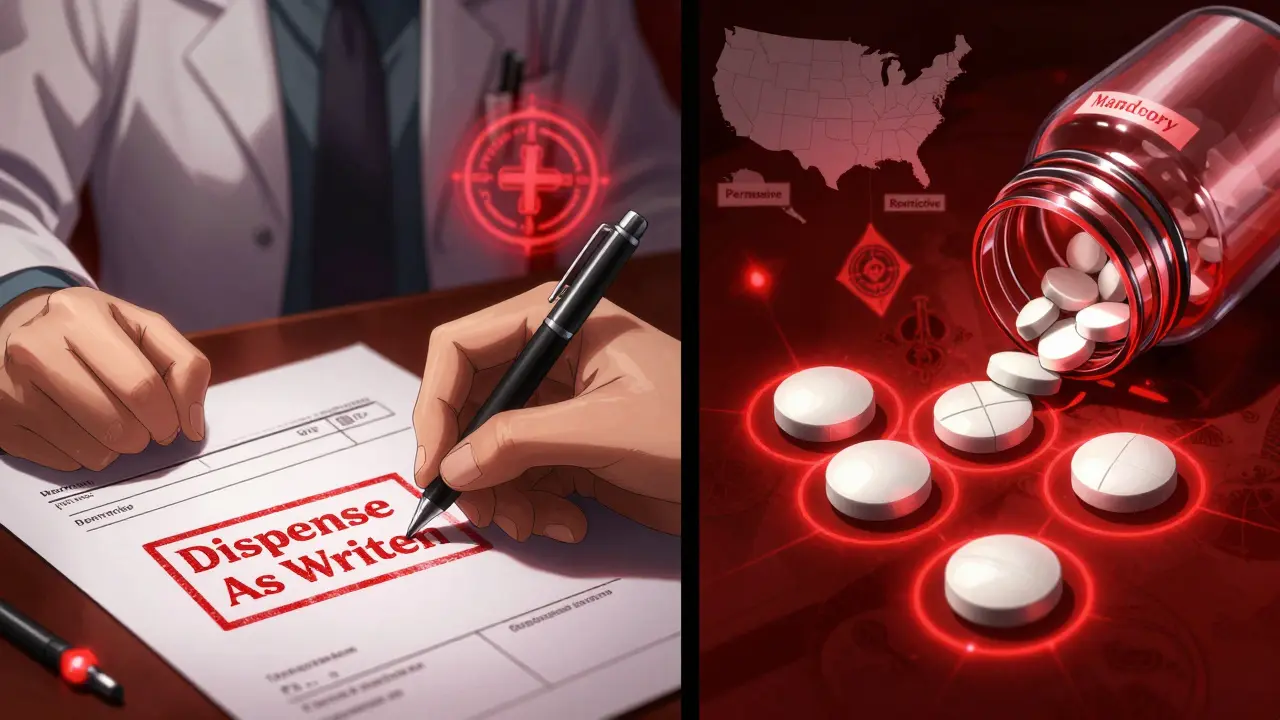
Special Rules for Biologics and Biosimilars
Biologics are a different beast. These are large, complex molecules made from living cells - think Humira, Enbrel, or insulin. They’re expensive, often over $10,000 a year. Biosimilars are similar, but not identical, versions. Only a few have been approved as "interchangeable" - meaning they can be swapped like generics. As of late 2023, only 10 biosimilars had interchangeable status. That means even if your doctor prescribes Humira, your pharmacist can’t swap it unless the biosimilar is labeled interchangeable AND your state allows it. Here’s where it gets messy:- 37 states require pharmacists to notify your doctor within 7 days after swapping a biosimilar.
- 12 states require your doctor to approve the swap before it happens.
- 15 states say the biosimilar must cost less than the brand - even if your insurance covers the brand at no extra cost to you.
What Your Doctor Can Do (And What They Should Do)
Your doctor can block substitution by writing "dispense as written" or "Do Not Substitute" on your prescription. In all 50 states, that’s legal. But in 18 states, they also have to explain why. That means if you’re on warfarin, they can’t just write "no substitution" - they have to say "due to narrow therapeutic index and risk of bleeding." In 28 states, doctors need to justify even a simple "no substitution" note. That adds paperwork - and delays. Many doctors don’t realize this. If you’ve been told your doctor won’t allow substitution, ask why. It might be a state rule, not their personal preference.What You Can Do as a Patient
You have rights - even if your state doesn’t make them obvious.- Ask before you pick up: "Is this the brand or the generic?" If it’s generic, ask if you can get the brand instead.
- Check your receipt: Look for the drug name and manufacturer. If it’s not what you expected, call the pharmacy.
- Know your NTI drugs: If you’re on warfarin, lithium, or phenytoin, never assume substitution is safe. Ask your pharmacist to confirm it’s the same brand you’ve always used.
- Request documentation: In states without notification rules, ask for a printed note about what was dispensed. Keep it in your medication log.
- Use your pharmacy’s app: Many pharmacies now show the drug name and manufacturer in your digital prescription history. Check it before leaving the store.

Why This Matters for Your Health
A 2018 study found that states with strict rules against substituting NTI drugs had 18% fewer adverse events. That’s not a small number. It means real people avoided hospital stays, bleeding episodes, or seizures because their state protected them. On the flip side, states that allow easy substitution save money - and that helps everyone. Insurance premiums stay lower. Out-of-pocket costs drop. More people can afford their meds. The trick is finding the balance. For most people, generics are safe. For others, they’re risky. The system isn’t perfect. But you can take control.How to Find Your State’s Rules
You don’t need to guess. Here’s how to get the facts:- Go to your state’s Board of Pharmacy website. Search for "[Your State] Board of Pharmacy substitution laws."
- Look for documents titled "Drug Product Selection Act" or "Generic Substitution Guidelines."
- Check if your state has a list of non-substitutable drugs - especially for NTI medications.
- Call your pharmacy and ask: "What are your rules for switching generics? Do you notify patients?"
What’s Changing in 2026
More biosimilars are getting interchangeable status. By 2030, they could make up 70% of the biologics market. That means more swaps - and more confusion. California and New York updated their laws in early 2023 to require stronger patient notifications for biosimilars. Other states are following. The National Association of Boards of Pharmacy is pushing for standardized rules across states - so if you move from Texas to Florida, you won’t get a different drug without knowing why. The bottom line? The system is moving toward more transparency - but you still need to be your own advocate.Can my pharmacist switch my brand-name drug without telling me?
In 19 states, yes - they can swap your brand for a generic without telling you at all. In 31 states and D.C., they must notify you after the fact. Only 7 states require your permission before the switch. Always check your prescription label and receipt. If you don’t recognize the drug name, call your pharmacy.
Are generic drugs really the same as brand-name drugs?
For most medications, yes. The FDA requires generics to have the same active ingredient, strength, dosage form, and route of administration as the brand. They must also be absorbed into the body at the same rate and extent. But for drugs with a narrow therapeutic index - like warfarin or phenytoin - even small differences can matter. That’s why some states block substitution for these drugs.
What’s the difference between a biosimilar and a generic?
Generics are exact copies of small-molecule drugs, like pills or capsules. Biosimilars are similar - but not identical - to complex biologic drugs made from living cells. Only biosimilars approved as "interchangeable" by the FDA can be swapped like generics. As of late 2023, only 10 out of 38 approved biosimilars have that status. Most can’t be substituted without your doctor’s approval.
Can I refuse a generic or biosimilar if I don’t want it?
Yes - in every state. You have the right to ask for the brand-name drug, even if your pharmacist says it’s not covered. You may have to pay more out of pocket, but you can’t be forced to take a substitute. If the pharmacist refuses, ask to speak to the manager or file a complaint with your state board of pharmacy.
Why does my state block substitution for some drugs?
States block substitution for drugs with a narrow therapeutic index - where small changes in blood levels can cause serious side effects. Common examples include warfarin, phenytoin, lithium, and levothyroxine. Studies show states with these restrictions have fewer hospitalizations and adverse events. If you’re on one of these drugs, always confirm the exact brand you’re getting - and never assume substitution is safe.


Amy Le
January 5 2026So let me get this straight - in 19 states, they can swap my life-saving meds without even a heads-up? 🤯 That’s not healthcare, that’s pharmaceutical Russian roulette. I’m on warfarin. One milligram off and I’m either bleeding out or clotting into a brick. And you want me to trust a pharmacist’s ‘therapeutic equivalence’ label? Nah. I’ll pay extra. My life isn’t a cost-cutting experiment. 🚫💊