

For those managing complex treatments, understanding therapeutic drug monitoring (TDM) isn't just for the doctors. It is about knowing that the system checking your levels is validated and verified. If a lab isn't following strict standards, it can lead to dosing errors that, according to Institute of Medicine data, contribute to 7,000 to 9,000 deaths annually in the US. Whether you are a patient or a provider, knowing how these labs confirm their accuracy is the only way to ensure patient safety.
The Difference Between Test Verification and Validation
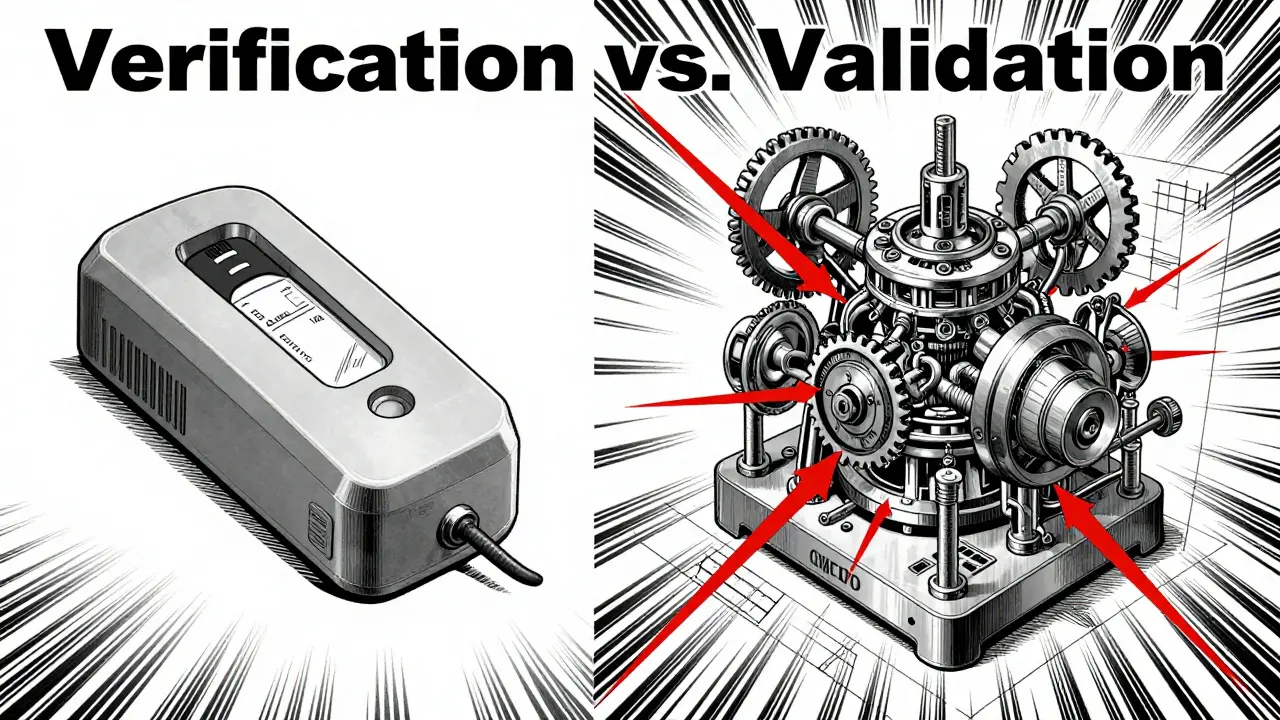
Not all lab tests are created equal. Depending on where the test comes from, the lab follows one of two paths to prove it works. Test Verification is the process of confirming that an FDA-cleared or approved test performs exactly as the manufacturer claims it does. Think of this like buying a pre-built piece of furniture; the instructions are there, and the lab just needs to prove it fits together correctly in their specific environment. This is common for routine drugs like lithium.
On the other hand, Test Validation is a comprehensive performance assessment used for laboratory-developed tests (LDTs) or modified FDA tests. This is more like building a custom piece of furniture from scratch. The lab has to prove every single measurement and safety standard from the ground up. This is necessary for rare medications, such as specific metabolites of clozapine, where no standard FDA-cleared test exists.
| Feature | Verification (FDA-Cleared) | Validation (LDTs) |
|---|---|---|
| Average Time Investment | 80 hours | 120 hours |
| Estimated Cost | $2,500 - $5,000 | $7,500 - $15,000 |
| Implementation Speed | Often under 30 days | 45 - 60 days |
| Primary Use Case | Routine drugs (e.g., Lithium) | Esoteric/Rare drugs |
The Nine Pillars of Lab Accuracy
To ensure a medication dose is adjusted safely, labs don't just run the test once. They follow guidelines, such as the CLSI EP15-A3, to check nine specific performance markers. If a lab fails any of these, the results cannot be trusted for patient care.
- Precision: Does the test give the same result if you run the same sample five times over five days?
- Trueness (Bias): How close is the result to the actual known value of the drug?
- Analytical Sensitivity: What is the absolute lowest amount of the drug the test can detect?
- Detection Limits: At what point can the lab confidently quantify the exact amount of the drug?
- Analytical Specificity: Does the test accidentally pick up other substances (interferences) and mistake them for the medication?
- Measuring Range: Does the test cover 80-120% of the therapeutic range needed for the drug?
- Linearity: Is there a straight-line relationship between the drug concentration and the signal the machine produces?
- Reportable Range: Can the lab report results across the entire therapeutic range plus a 20% buffer?
- Measurement Uncertainty: What is the statistical "margin of error" for the final result?
Why Interference Testing is a Critical Safety Net
One of the biggest dangers in medication monitoring is "cross-reactivity." This happens when the lab test mistakes a metabolite (a breakdown product of the drug) for the active drug itself. Dr. James Nichols from Vanderbilt University has pointed out that inadequate interference testing is the most common error in implementation. For drugs like carbamazepine, this can lead to false results in 5-8% of samples.
Take tacrolimus, a common immunosuppressant used after organ transplants. Because it has many metabolites, the FDA recently updated its guidance in January 2024. Labs are now required to verify cross-reactivity with 15 major metabolites instead of just 8. When Mayo Clinic implemented a novel tacrolimus assay, their rigorous validation caught metabolite interference in 17% of samples. Without that check, those patients would have received incorrect doses, potentially risking organ rejection or toxicity.
Navigating the Regulatory Landscape
You can't just start a monitoring lab in a basement. In the US, the CLIA '88 (Clinical Laboratory Improvement Amendments) regulations make these verification steps mandatory. If a lab skips these steps, they face fines averaging $7,500 per violation. Most high-quality labs also follow the APHL Toolkit, which provides standardized worksheets to prevent human error during the setup phase.
For those looking for the gold standard, ISO 15189 accreditation is the benchmark. Research shows that laboratories following these international requirements have 47% fewer medication-related errors. This is because they treat the verification process as a living system rather than a one-time checklist.
Step-by-Step: How Labs Implement Monitoring
If you are working with a provider to set up a new monitoring protocol, this is the internal journey the lab takes to ensure your results are right:
- The Plan: The lab spends 8-16 hours developing a verification or validation plan.
- Director Approval: A lab director must sign off on the plan to ensure it meets safety standards.
- The Testing Phase: The lab runs dozens of replicates (often 20+ samples over 5 days) to test precision.
- Data Analysis: Statisticians check if the R² value for linearity is ≥0.99.
- Re-evaluation: About 30% of tests fail the first round and require a "re-do" to fix calibration issues.
- Reporting: A final summary report is generated, documenting every failure and success.
- SOP Creation: Standard Operating Procedures are written so every technician performs the test identically.
- Final Sign-off: A final administrative approval is granted.
- Live Implementation: The test is finally used on actual patient samples.

Common Pitfalls and Patient Risks
Despite the rules, gaps still exist. A 2023 CAP survey found that only 64% of laboratories verify the lower limit of quantitation for narrow therapeutic index drugs. Why does this matter? Because if the lab can't accurately detect very low levels, they might miss a "sub-therapeutic" result. This means a patient might be taking a dose that is too low to be effective, but the lab report makes it look like it's within range.
Another risk is the "resource crunch." Many community hospitals lack the staff to perform these 100+ hour verification processes properly. When labs are understaffed, documentation often becomes the first thing to suffer. This is why it is always a good idea to ask your provider if the lab they use is CAP-accredited or ISO-certified.
What is a "narrow therapeutic index" drug?
These are medications where the difference between a dose that heals and a dose that harms is very small. Examples include digoxin and warfarin. Because the window of safety is so narrow, the lab tests used to monitor them must have extremely tight specifications (e.g., total error ≤10% for digoxin).
How can I tell if my lab results are reliable?
Check if the laboratory is accredited by the College of American Pathologists (CAP) or holds ISO 15189 certification. You can also ask your provider if the lab uses FDA-cleared assays or laboratory-developed tests (LDTs), as the latter require more intense validation.
What happens if a lab result is wrong?
Inaccurate results can lead to incorrect dose adjustments. This can cause toxicity (too much drug) or treatment failure (too little drug). In severe cases, such as with heart medications like digoxin, antibody cross-reactivity in unverified tests has led to patients receiving dangerous dosages.
How often should these labs be "re-verified"?
While initial verification happens during setup, labs perform "quality control" (QC) daily. Full re-verification usually happens when the lab changes its instrument, updates the software, or the manufacturer changes the reagent formulation.
Does the time of the blood draw affect the monitoring result?
Yes. For most TDM, a "trough level" is required, meaning the blood is drawn immediately before the next dose. If the timing is off, the lab result will be misleading, regardless of how verified the lab's equipment is.
Next Steps for Patients and Providers
If you are a patient, don't be afraid to ask your doctor, "Is this lab CAP-accredited?" or "How often is this test calibrated?" Understanding the system helps you advocate for your own safety. For providers, ensure that your preferred laboratory provides a summary of their verification performance, especially for narrow therapeutic index drugs.
Looking ahead, the industry is moving toward integrated EHR systems, like those from Epic, which will automatically flag sub-therapeutic levels in real-time. This reduces the human error associated with interpreting a lab report and ensures that follow-up happens immediately, not days later when a clinician finally reviews a portal.