
What Is Gastroparesis?
Gastroparesis is a condition where the stomach takes too long to empty food into the small intestine, even when there’s no physical blockage. This isn’t just slow digestion-it’s a breakdown in the stomach’s ability to contract and grind food into a digestible slurry. The vagus nerve, which normally signals the stomach to move food along, gets damaged or doesn’t work right. As a result, food sits in the stomach for hours, sometimes days.
People with gastroparesis don’t just feel full after eating a small meal-they often feel sick, bloated, or nauseous for hours afterward. About 90% of patients report nausea, and 75-80% vomit regularly. Early satiety-feeling full after just a few bites-is the most common symptom, affecting 85% of those diagnosed. These symptoms don’t come and go; they stick around for at least three months before doctors even consider diagnosing gastroparesis.
It’s more common in women, with four times as many cases as in men. And if you have diabetes, especially type 1, your risk jumps dramatically. Up to half of long-term type 1 diabetics and about 30% of type 2 diabetics develop gastroparesis. That’s because high blood sugar damages nerves over time, including the vagus nerve. But not everyone with gastroparesis has diabetes. About 30% of cases have no known cause-these are called idiopathic gastroparesis.
How Is It Diagnosed?
Doctors don’t diagnose gastroparesis based on symptoms alone. Too many other conditions-like acid reflux, peptic ulcers, or even anxiety-can mimic it. The gold standard test is a gastric emptying study. You eat a meal with a tiny bit of radioactive material, then a scanner tracks how fast it leaves your stomach. If less than 40% of the meal is gone after two hours, that’s a clear sign of delayed emptying.
Some clinics use breath tests or wireless motility capsules, but scintigraphy is still the most trusted method. Doctors also rule out blockages with an endoscopy or ultrasound. If your stomach looks normal but food still isn’t moving, gastroparesis is likely.
There are three levels: mild, moderate, and severe. Mild cases might only need diet changes. Moderate cases often require medication. Severe cases can lead to hospitalization, feeding tubes, or even surgery. The severity isn’t just about how much food stays in your stomach-it’s about how much it disrupts your life. Many people can’t work full-time. Others avoid social events because they’re scared of vomiting in public.
What Foods Make It Worse?
Not all foods are created equal when your stomach won’t empty. High-fat foods are the worst offenders. Fatty meals can delay emptying by 30-50%. That means fried chicken, cheese, butter, cream sauces, and even avocado can make symptoms spike. Carbonated drinks like soda or sparkling water add gas to an already bloated stomach, increasing pressure by 25% and triggering nausea.
Fiber is another problem. Raw vegetables, whole grains, nuts, seeds, and skins on fruits like apples or pears are hard to break down. They can clump together and form bezoars-solid masses of undigested food that block the stomach. About 6% of gastroparesis patients develop bezoars, and 2% need surgery to remove them.
Meat, especially tough cuts like steak or pork shoulder, stays intact too long. Fibrous foods like celery, broccoli, and corn are also troublemakers. Even chewing thoroughly won’t fix it if the stomach can’t process the chunks.
What Should You Eat Instead?
The goal is simple: make food as easy to digest as possible. That means low fat, low fiber, and soft or blended textures. Meals should be small-1 to 1.5 cups max-and eaten 5 to 6 times a day. Skipping meals makes symptoms worse because the stomach gets too full when you finally eat.
Good options include:
- Smoothies made with cooked fruit (bananas, peeled apples), yogurt, and protein powder
- Blended soups (chicken noodle, tomato, butternut squash-strained to remove chunks)
- Well-cooked vegetables like carrots, zucchini, or spinach (peeled and mashed)
- Lean proteins like ground turkey, chicken breast, eggs, or tofu (chopped fine or pureed)
- Refined grains like white rice, white bread, or pasta (no whole grains)
- Low-fat dairy like skim milk, cottage cheese, or custard
Hydration matters too. Sip water-1 to 2 ounces every 15 minutes. Don’t chug. Large amounts of liquid at once stretch the stomach and make bloating worse. Avoid drinking with meals. Wait 30 minutes after eating solids before sipping fluids. This keeps gastric volume down by 40%.
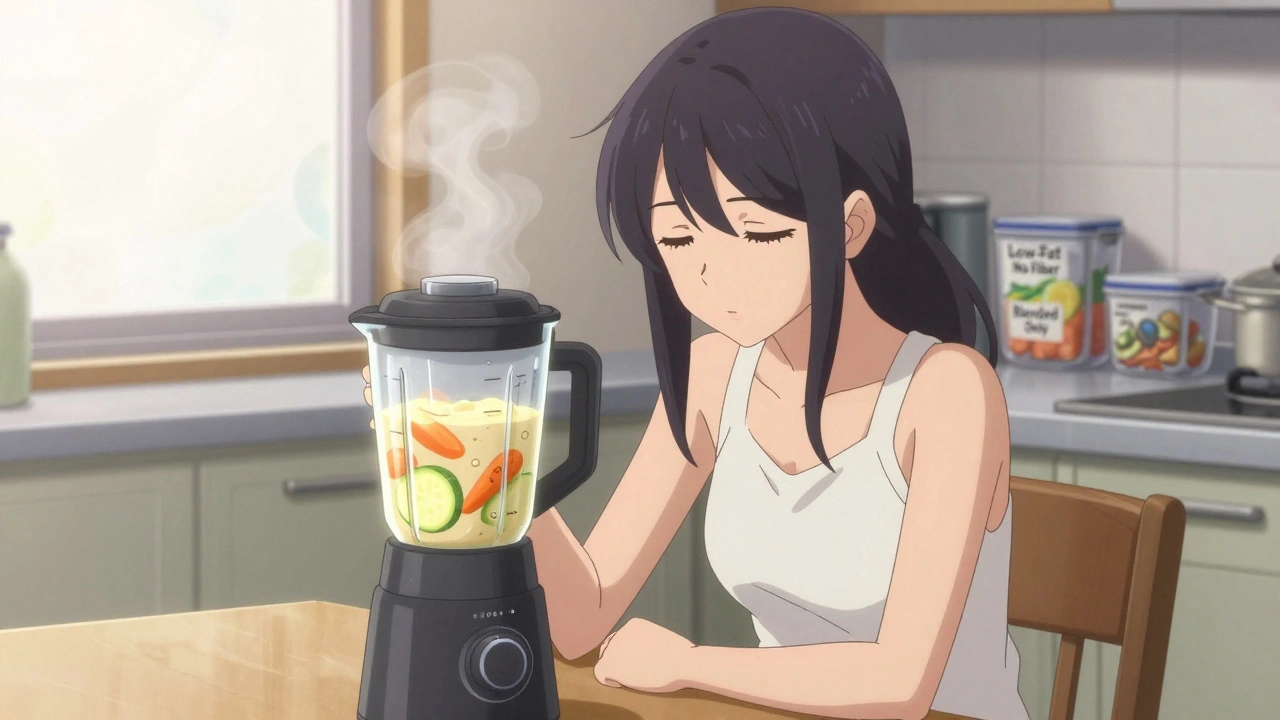
Some people need to blend everything. If you’re struggling, use a high-speed blender to turn meals into smooth liquids. A particle size under 2 millimeters is ideal. Studies show 70% of patients feel better when they follow this rule.

How Diet Alone Can Help
Here’s the good news: diet changes work. About 65% of people see major symptom improvement just by adjusting what they eat. That’s more than half of patients who don’t need medication or surgery.
One study found that after 8 to 12 weeks on a structured gastroparesis diet, 60% of patients had more than half their symptoms go away. They reported less vomiting, less bloating, and more energy. Many could finally eat out with friends again.
The key is consistency. It’s not about eating healthy in general-it’s about eating the right texture, the right portions, and the right timing. Keeping a food diary helps. Write down what you ate, when, and how you felt two hours later. Most people find 3 to 5 trigger foods they didn’t even realize were the problem.
Working with a registered dietitian who specializes in gastroparesis boosts success by 40%. They don’t just give you a list-they help you build meals you can stick with. They adjust calorie needs, check for nutrient gaps, and help you avoid malnutrition.
When Diet Isn’t Enough
For moderate to severe cases, diet alone isn’t enough. Medications can help, but they come with risks. Metoclopramide is the most common prokinetic-it speeds up stomach emptying by 20-25%. But after long-term use, it can cause involuntary movements called tardive dyskinesia. That’s why doctors limit it to 12 weeks at a time.
Other drugs like erythromycin (an antibiotic that also stimulates contractions) are sometimes used short-term. But they lose effectiveness over time and can cause diarrhea.
If medications fail, there are advanced options. Gastric electrical stimulation (GES) is a device implanted like a pacemaker. It sends mild pulses to the stomach muscles. In 70% of patients, it cuts vomiting by more than half. It’s FDA-approved and covered by most insurance.
A newer procedure called per-oral pyloromyotomy (POP) cuts the muscle at the bottom of the stomach to let food pass more easily. In clinical trials, 60-70% of patients had major improvement. It’s minimally invasive and doesn’t require open surgery.
For the most severe cases-where weight loss is extreme or nutrition can’t be maintained-feeding tubes or IV nutrition may be needed. About 20-25% of severe patients end up needing one. It’s not a cure, but it keeps people alive and out of the hospital.
Complications You Can’t Ignore
Gastroparesis isn’t just uncomfortable-it’s dangerous if left unchecked. Malnutrition affects 30-40% of chronic patients. Many lose more than 10% of their body weight. Blood sugar swings in diabetics get wild, making diabetes harder to control. In fact, 85% of diabetic gastroparesis patients have unpredictable glucose levels.
Dehydration is common. Persistent vomiting means losing fluids and electrolytes. About 25% of moderate to severe cases lead to hospitalization for IV fluids. Hypokalemia (low potassium) is a frequent finding.
Bezoars can cause blockages, infections, or even perforations. Hospital stays average 5.2 days per admission, and people with severe gastroparesis are hospitalized about 3.5 times a year. The annual cost per patient is nearly $20,000.
And the mental toll? Real. Seventy-five percent say it limits daily life. Half report social isolation. Sixty-five percent feel anxious about eating. Some develop feeding aversion-fearing food because it makes them sick. Counseling and support groups help. You’re not alone.

What’s Next for Treatment?
Research is moving fast. In 2022, the FDA approved relamorelin, a new drug that mimics a natural hormone to speed up stomach emptying. In trials, it improved emptying by 35%. More drugs like it are coming in the next two to three years.
Scientists are also looking at the gut microbiome. Early studies show that specific probiotics can reduce nausea and bloating by 30%. AI is being used to analyze gastric emptying scans more accurately-improving diagnosis by 25%.
The biggest shift? Personalized treatment. Doctors now recognize three subtypes of gastroparesis: nausea-dominant, bloating-dominant, and pain-dominant. Each responds better to different therapies. Within five years, you’ll likely get a treatment plan tailored to your exact symptoms, not just a one-size-fits-all approach.
Final Thoughts: You Can Take Control
Gastroparesis doesn’t have a cure. But it doesn’t have to control your life. The most powerful tool you have is your diet. Small meals. Low fat. Low fiber. Blended when needed. Hydration in sips. And patience.
It takes time to adjust. You’ll have setbacks. But 60% of people who stick with the plan see their symptoms cut in half within a few months. You can eat again. You can go out. You can sleep through the night.
Start with one change: swap your big lunch for three small meals. Try blending your vegetables. Track your symptoms. Talk to a dietitian. You don’t have to do this alone.
Can gastroparesis go away on its own?
In rare cases, especially if it’s caused by a temporary issue like a viral infection or surgery, gastroparesis can improve or resolve. But for most people-especially those with diabetes or idiopathic causes-it’s a chronic condition. That doesn’t mean it’s untreatable. With the right diet and care, symptoms can be managed effectively for years.
Is a liquid diet the only option?
No. While liquid meals are helpful early on, many people transition to soft, well-cooked, and blended solid foods. The goal isn’t to live on shakes forever-it’s to find textures your stomach can handle. Pureed soups, mashed potatoes, ground meats, and scrambled eggs are all part of a balanced gastroparesis diet.
Can I still eat fruit?
Yes-but only cooked or blended fruits without skins or seeds. Applesauce, peeled and cooked pears, bananas, and melon are usually well-tolerated. Avoid raw apples, berries, oranges, and pineapple, which are high in fiber and can trigger symptoms.
Does stress make gastroparesis worse?
Yes. Stress slows digestion and worsens nausea and bloating. While it doesn’t cause gastroparesis, it can amplify symptoms. Many patients benefit from mindfulness, therapy, or gentle exercise like walking to help manage stress and improve gut-brain communication.
How long does it take to see results from dietary changes?
Most people notice improvement within 2 to 4 weeks, especially with smaller meals and avoiding trigger foods. Major symptom reduction-like less vomiting or bloating-usually happens by 8 to 12 weeks. Consistency is key. One slip-up won’t ruin progress, but frequent backsliding will.
Can I drink alcohol with gastroparesis?
It’s not recommended. Alcohol slows gastric emptying and irritates the stomach lining. It can worsen nausea, bloating, and dehydration. If you choose to drink, limit it to tiny amounts of clear liquor with no mixers, and never on an empty stomach. Most patients are better off avoiding it entirely.
Will I need surgery someday?
Only a small percentage-about 5-10%-progress to the point where surgery is needed. Most people manage with diet, medication, or non-surgical procedures like GES or POP. Surgery is a last resort for those who don’t respond to other treatments and are losing weight or getting frequent infections.
Next Steps: What to Do Today
Start simple. Pick one change and stick with it for a week:
- Replace your biggest meal with two smaller ones spaced 2-3 hours apart.
- Blend one meal a day-like soup or a smoothie-until it’s completely smooth.
- Write down everything you eat and how you feel 2 hours later.
- Call a dietitian who specializes in gastroparesis. Most hospitals have one.
- Stop drinking carbonated beverages and switch to still water in small sips.
You don’t need to fix everything at once. Progress, not perfection, is the goal. Gastroparesis is challenging, but with the right approach, you can eat, feel better, and live well.


Larry Lieberman
December 9 2025This is the most comprehensive guide I've ever seen on gastroparesis. Seriously, someone should turn this into a PDF handout for every GI clinic. I’ve been on this diet for 6 months and the difference is night and day. Blending my meals was the game-changer. No more midnight vomiting sessions. 🙌