

Drinking a glass of calcium-fortified orange juice with your morning pill might seem like a smart way to boost your bones and get your vitamins. But if you're taking certain medications, that habit could be silently sabotaging your treatment-without you even knowing it.
Why Calcium-Fortified Juices Are a Problem
Calcium-fortified juices, like Tropicana High Calcium or Minute Maid Plus Calcium, are designed to give you the same amount of calcium as a glass of milk-around 300 to 350 mg per 8-ounce serving. That sounds great if you're lactose intolerant or trying to hit your daily calcium goal. But here’s the catch: calcium doesn’t just help your bones. It also binds tightly to certain drugs in your gut, forming complexes your body can’t absorb.This isn’t just a theory. Studies show that when you take antibiotics like ciprofloxacin or doxycycline with calcium-fortified juice, your body absorbs up to 80% less of the drug. That means your UTI, sinus infection, or acne treatment might not work at all. In one study of 412 patients, those who drank calcium-fortified orange juice with ciprofloxacin had a 25-30% failure rate in treating urinary tract infections. Those who waited? Only 8-10% failed.
Which Medications Are Affected?
Not all meds are equally vulnerable, but the ones that are, are critical. Here’s the short list of drugs that can be seriously weakened by calcium-fortified juices:- Tetracycline antibiotics (doxycycline, minocycline): Calcium blocks absorption completely. Your infection won’t clear.
- Fluoroquinolones (ciprofloxacin, levofloxacin): Same issue. Even a single glass can cut drug levels by half.
- Bisphosphonates (alendronate/Fosamax): Used for osteoporosis. If you take them with calcium juice, you’re wasting your money. These drugs need an empty stomach and zero calcium for 30 minutes to 2 hours.
- Levothyroxine (Synthroid, Levoxyl): This one’s dangerous. A 2021 study found calcium-fortified juice reduces levothyroxine absorption by 35-55%. Patients ended up needing 25-50 mcg higher doses just to get their thyroid levels back on track.
- Ketoconazole: An antifungal that needs stomach acid to work. Calcium-fortified juice doesn’t just bind the drug-it changes your stomach pH, making absorption even worse.
And it’s not just calcium. Orange juice adds citric acid, which further disrupts how these drugs dissolve. One study compared calcium-fortified orange juice to plain calcium-fortified water. The orange juice cut ciprofloxacin absorption by 42%. The plain version? Just 31%. The acid makes it worse.
How Long Should You Wait?
Timing matters. You can’t just sip your juice an hour after your pill and call it good. The separation window depends on the drug:- Tetracyclines: Wait 2-3 hours before or after drinking calcium juice.
- Bisphosphonates: Take on an empty stomach, wait 30 minutes before eating or drinking anything, then wait 2 more hours before having calcium.
- Levothyroxine: Wait at least 4 hours. Many patients take it at bedtime to avoid this conflict entirely.
- Fluoroquinolones: Stick to a 2-hour buffer, but 4 hours is safer.
And no, “I drank it 30 minutes before” doesn’t cut it. Calcium stays in your gut for hours. It’s not like caffeine-it doesn’t flush out quickly.
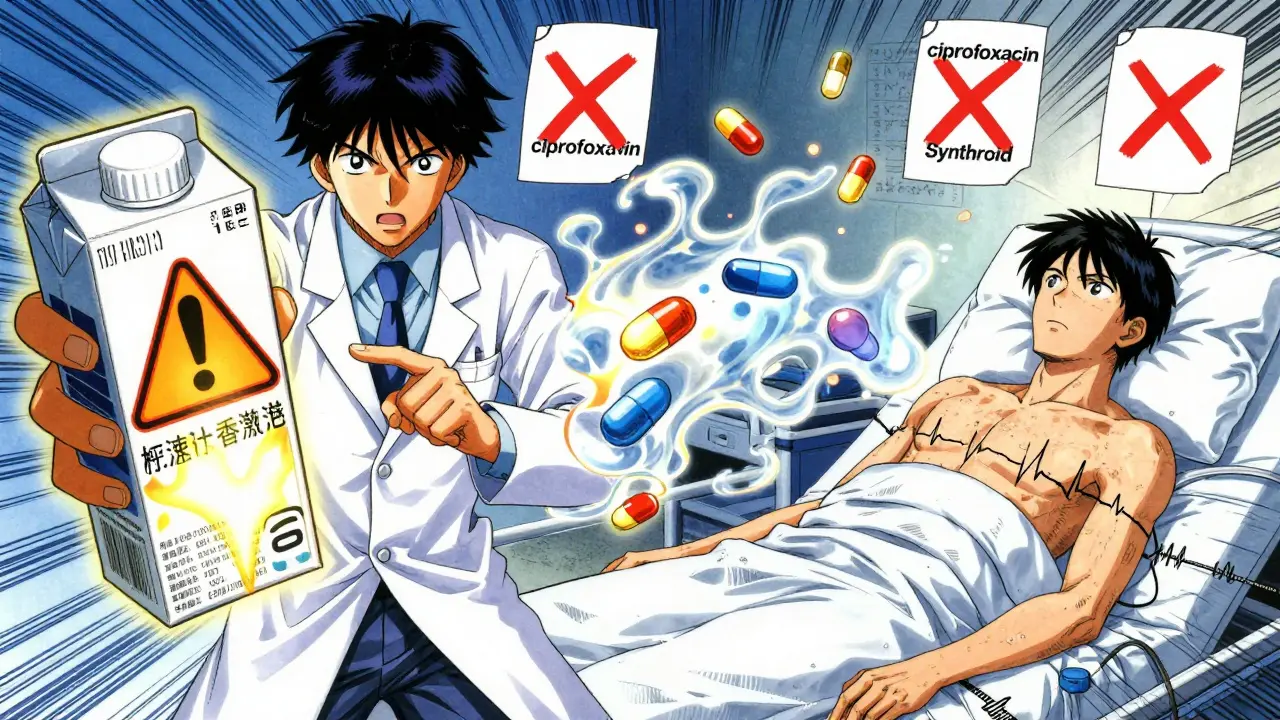
Why Doctors Don’t Always Tell You
Here’s the frustrating part: most patients don’t know about this interaction. A 2022 survey by the National Community Pharmacists Association found that 68% of people think calcium-fortified juices are “safe” with medications. Even more alarming: only 28% of patients recall ever being warned about it by their doctor or pharmacist.Pharmacists see it all the time. A 2023 survey of 512 community pharmacists showed that 73% regularly encounter patients taking calcium-fortified juice with affected drugs. Yet, most patients don’t even realize it’s a problem. Why? Because the labels on juice cartons don’t warn you. A 2023 study analyzed 47 popular calcium-fortified juice brands. Ninety-two percent had no warning about drug interactions on the packaging.
Meanwhile, drug labels often have the warning buried in tiny print. If you’re not reading the full prescribing information, you’ll miss it. And most people don’t.
Real Stories, Real Consequences
Online forums are full of people who didn’t know until it was too late.One woman on Drugs.com wrote: “My doctor never mentioned calcium OJ would interfere with my Synthroid-I was drinking two glasses daily with my morning pill for six months before my TSH levels finally got checked and were sky-high.” Her thyroid was underactive. Her energy was gone. She thought it was stress. It was the juice.
Another Reddit user shared: “I took cipro for a UTI. I drank my calcium OJ like always. Three days later, I was back in the ER. The infection had spread. The pharmacist said it was probably the juice.”
These aren’t rare cases. The Institute for Safe Medication Practices logged 147 reported incidents of treatment failure linked to calcium-fortified beverages in just two years. That number is up 37% from the previous period.

The Financial Cost
This isn’t just about feeling bad. It’s about money. A 2022 analysis estimated that these interactions cost the U.S. healthcare system $417 million annually. That’s from repeat doctor visits, unnecessary lab tests, hospital stays, and extra prescriptions because the first treatment failed.Imagine if every patient who drank calcium juice with their levothyroxine got their levels checked once a year instead of three times. Or if their UTI cleared the first time instead of requiring a stronger antibiotic. That’s where the savings are.
What Should You Do?
If you take any of the medications listed above, here’s your action plan:- Check your meds. Look up your prescription online or ask your pharmacist: “Does this interact with calcium?”
- Read your juice label. If it says “fortified with calcium,” assume it’s a problem.
- Separate them. Take your pill with water. Wait at least 2-4 hours before drinking calcium juice. Better yet, drink it with dinner, not breakfast.
- Ask your pharmacist. They’re trained to catch these interactions. Don’t assume your doctor told you everything.
- Switch to non-fortified juice. If you need vitamin C or potassium, regular orange juice (without added calcium) is fine.
And if you’re taking levothyroxine? The safest bet is to take it first thing in the morning on an empty stomach with a full glass of water, and wait four hours before eating or drinking anything else. That includes coffee, soy milk, fiber supplements, and yes-calcium-fortified juice.
What’s Being Done?
The FDA is finally paying attention. Their 2023 draft guidance says juice makers need to add interaction warnings on packaging. Some companies are experimenting with new calcium forms that don’t bind as tightly-like the chelation-resistant calcium complex patented by Nestlé in 2023. Pharmacies are testing QR codes on medication bottles that link to food interaction guides.But until those changes roll out, the responsibility falls on you. No one else is going to remind you. Your doctor is busy. Your pharmacist might not see you unless you ask. And your juice bottle won’t warn you.
So if you’re on medication-especially antibiotics, thyroid meds, or osteoporosis drugs-ask yourself: Am I drinking calcium-fortified juice? If yes, when? And is it interfering with my treatment?
It’s not about giving up your juice. It’s about timing it right.


William Liu
December 19 2025This is one of those things that sounds too simple to be true, but it's terrifyingly accurate. I took doxycycline for acne and drank my daily calcium OJ without a second thought. Three weeks in, my skin got worse. I thought the drug stopped working. Turns out, it never even started.
Now I take my pill with water at 7 AM and my juice at dinner. No more drama.